 b06c5a4b9e
Signed-off-by: Glenn Jocher <glenn.jocher@ultralytics.com>
Co-authored-by: UltralyticsAssistant <web@ultralytics.com>
9.7 KiB
| comments | description | keywords |
|---|---|---|
| true | Explore Meituan YOLOv6, a top-tier object detector balancing speed and accuracy. Learn about its unique features and performance metrics on Ultralytics Docs. | Meituan YOLOv6, object detection, real-time applications, BiC module, Anchor-Aided Training, COCO dataset, high-performance models, Ultralytics Docs |
Meituan YOLOv6
Overview
Meituan YOLOv6 is a cutting-edge object detector that offers remarkable balance between speed and accuracy, making it a popular choice for real-time applications. This model introduces several notable enhancements on its architecture and training scheme, including the implementation of a Bi-directional Concatenation (BiC) module, an anchor-aided training (AAT) strategy, and an improved backbone and neck design for state-of-the-art accuracy on the COCO dataset.
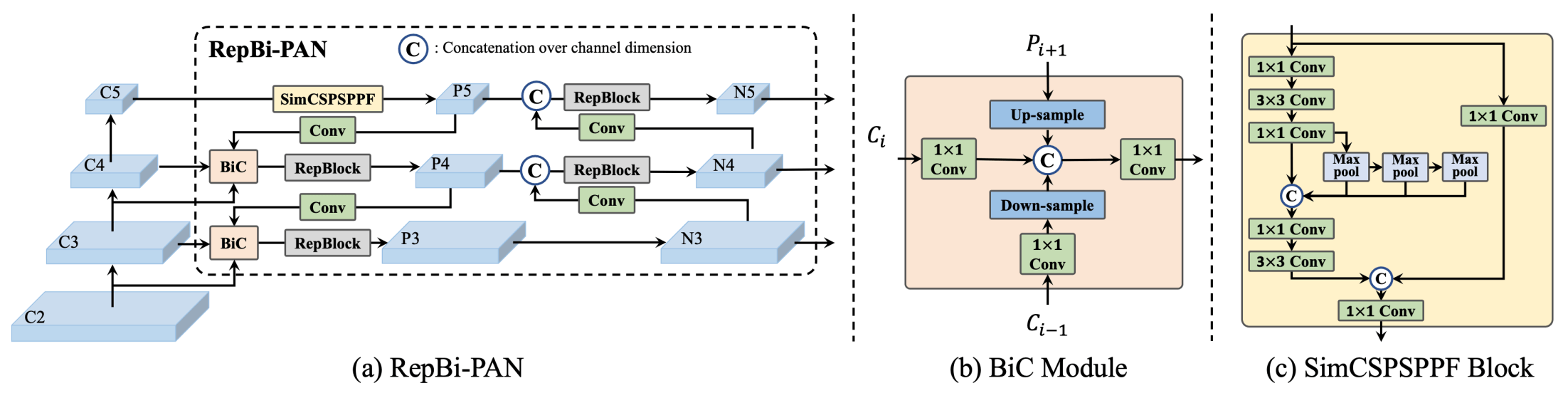 Overview of YOLOv6. Model architecture diagram showing the redesigned network components and training strategies that have led to significant performance improvements. (a) The neck of YOLOv6 (N and S are shown). Note for M/L, RepBlocks is replaced with CSPStackRep. (b) The structure of a BiC module. (c) A SimCSPSPPF block. (source).
Key Features
- Bidirectional Concatenation (BiC) Module: YOLOv6 introduces a BiC module in the neck of the detector, enhancing localization signals and delivering performance gains with negligible speed degradation.
- Anchor-Aided Training (AAT) Strategy: This model proposes AAT to enjoy the benefits of both anchor-based and anchor-free paradigms without compromising inference efficiency.
- Enhanced Backbone and Neck Design: By deepening YOLOv6 to include another stage in the backbone and neck, this model achieves state-of-the-art performance on the COCO dataset at high-resolution input.
- Self-Distillation Strategy: A new self-distillation strategy is implemented to boost the performance of smaller models of YOLOv6, enhancing the auxiliary regression branch during training and removing it at inference to avoid a marked speed decline.
Performance Metrics
YOLOv6 provides various pre-trained models with different scales:
- YOLOv6-N: 37.5% AP on COCO val2017 at 1187 FPS with NVIDIA Tesla T4 GPU.
- YOLOv6-S: 45.0% AP at 484 FPS.
- YOLOv6-M: 50.0% AP at 226 FPS.
- YOLOv6-L: 52.8% AP at 116 FPS.
- YOLOv6-L6: State-of-the-art accuracy in real-time.
YOLOv6 also provides quantized models for different precisions and models optimized for mobile platforms.
Usage Examples
This example provides simple YOLOv6 training and inference examples. For full documentation on these and other modes see the Predict, Train, Val and Export docs pages.
!!! Example
=== "Python"

    PyTorch pretrained `*.pt` models as well as configuration `*.yaml` files can be passed to the `YOLO()` class to create a model instance in python:

    ```python
    from ultralytics import YOLO

    # Build a YOLOv6n model from scratch
    model = YOLO("yolov6n.yaml")

    # Display model information (optional)
    model.info()

    # Train the model on the COCO8 example dataset for 100 epochs
    results = model.train(data="coco8.yaml", epochs=100, imgsz=640)

    # Run inference with the YOLOv6n model on the 'bus.jpg' image
    results = model("path/to/bus.jpg")
    ```

=== "CLI"

    CLI commands are available to directly run the models:

    ```bash
    # Build a YOLOv6n model from scratch and train it on the COCO8 example dataset for 100 epochs
    yolo train model=yolov6n.yaml data=coco8.yaml epochs=100 imgsz=640

    # Build a YOLOv6n model from scratch and run inference on the 'bus.jpg' image
    yolo predict model=yolov6n.yaml source=path/to/bus.jpg
    ```
Supported Tasks and Modes
The YOLOv6 series offers a range of models, each optimized for high-performance Object Detection. These models cater to varying computational needs and accuracy requirements, making them versatile for a wide array of applications.
| Model Type | Pre-trained Weights | Tasks Supported | Inference | Validation | Training | Export |
|---|---|---|---|---|---|---|
| YOLOv6-N | yolov6-n.pt |
Object Detection | ✅ | ✅ | ✅ | ✅ |
| YOLOv6-S | yolov6-s.pt |
Object Detection | ✅ | ✅ | ✅ | ✅ |
| YOLOv6-M | yolov6-m.pt |
Object Detection | ✅ | ✅ | ✅ | ✅ |
| YOLOv6-L | yolov6-l.pt |
Object Detection | ✅ | ✅ | ✅ | ✅ |
| YOLOv6-L6 | yolov6-l6.pt |
Object Detection | ✅ | ✅ | ✅ | ✅ |
This table provides a detailed overview of the YOLOv6 model variants, highlighting their capabilities in object detection tasks and their compatibility with various operational modes such as Inference, Validation, Training, and Export. This comprehensive support ensures that users can fully leverage the capabilities of YOLOv6 models in a broad range of object detection scenarios.
Citations and Acknowledgements
We would like to acknowledge the authors for their significant contributions in the field of real-time object detection:
!!! Quote ""
=== "BibTeX"

    ```bibtex
    @misc{li2023yolov6,
          title={YOLOv6 v3.0: A Full-Scale Reloading},
          author={Chuyi Li and Lulu Li and Yifei Geng and Hongliang Jiang and Meng Cheng and Bo Zhang and Zaidan Ke and Xiaoming Xu and Xiangxiang Chu},
          year={2023},
          eprint={2301.05586},
          archivePrefix={arXiv},
          primaryClass={cs.CV}
    }
    ```
The original YOLOv6 paper can be found on arXiv. The authors have made their work publicly available, and the codebase can be accessed on GitHub. We appreciate their efforts in advancing the field and making their work accessible to the broader community.
FAQ
What is Meituan YOLOv6 and how does it differ from other YOLO models?
Meituan YOLOv6 is a highly advanced object detection model that balances speed and accuracy, making it ideal for real-time applications. This model features unique enhancements such as the Bidirectional Concatenation (BiC) module, Anchor-Aided Training (AAT) strategy, and an improved backbone and neck design, providing state-of-the-art performance on the COCO dataset. Unlike prior YOLO models, YOLOv6 incorporates these innovative strategies to enhance both inference speed and detection accuracy.
How do I use the YOLOv6 model in a Python script?
Using the YOLOv6 model in a Python script is straightforward. Here is a sample code snippet to get you started:
from ultralytics import YOLO

# Build a YOLOv6n model from scratch
model = YOLO("yolov6n.yaml")

# Display model information (optional)
model.info()

# Train the model on the COCO8 example dataset for 100 epochs
results = model.train(data="coco8.yaml", epochs=100, imgsz=640)

# Run inference with the YOLOv6n model on the 'bus.jpg' image
results = model("path/to/bus.jpg")
For more detailed examples and documentation, visit the Train and Predict pages.
What are the performance metrics for different scales of YOLOv6 models?
YOLOv6 offers pretrained models in various scales with the following performance metrics on the COCO val2017 dataset:
- YOLOv6-N: 37.5% AP at 1187 FPS using an NVIDIA Tesla T4 GPU
- YOLOv6-S: 45.0% AP at 484 FPS
- YOLOv6-M: 50.0% AP at 226 FPS
- YOLOv6-L: 52.8% AP at 116 FPS
- YOLOv6-L6: State-of-the-art accuracy for real-time
These metrics make YOLOv6 a versatile choice for both high-accuracy and high-speed applications.
What are the unique features of YOLOv6 that improve its performance?
YOLOv6 introduces several key features that enhance its performance:
- Bidirectional Concatenation (BiC) Module: Improves localization signals and offers performance gains with minimal speed degradation.
- Anchor-Aided Training (AAT) Strategy: Combines the benefits of anchor-based and anchor-free methods for better efficiency without sacrificing inference speed.
- Enhanced Backbone and Neck Design: Adds additional stages to the backbone and neck, achieving state-of-the-art results on high-resolution inputs.
- Self-Distillation Strategy: Boosts smaller model performance by refining the auxiliary regression branch during training and removing it during inference to maintain speed.
How can YOLOv6 be used for mobile and embedded applications?
YOLOv6 supports quantized models for different precisions and models optimized for mobile platforms, making it suitable for applications requiring low-latency and energy-efficient computations. For deployment on mobile and edge devices, you can explore conversion to formats like TFLite and ONNX, as detailed in the Export documentation. Quantized models ensure high performance even on resource-constrained devices, enabling real-time object detection in mobile and IoT applications.